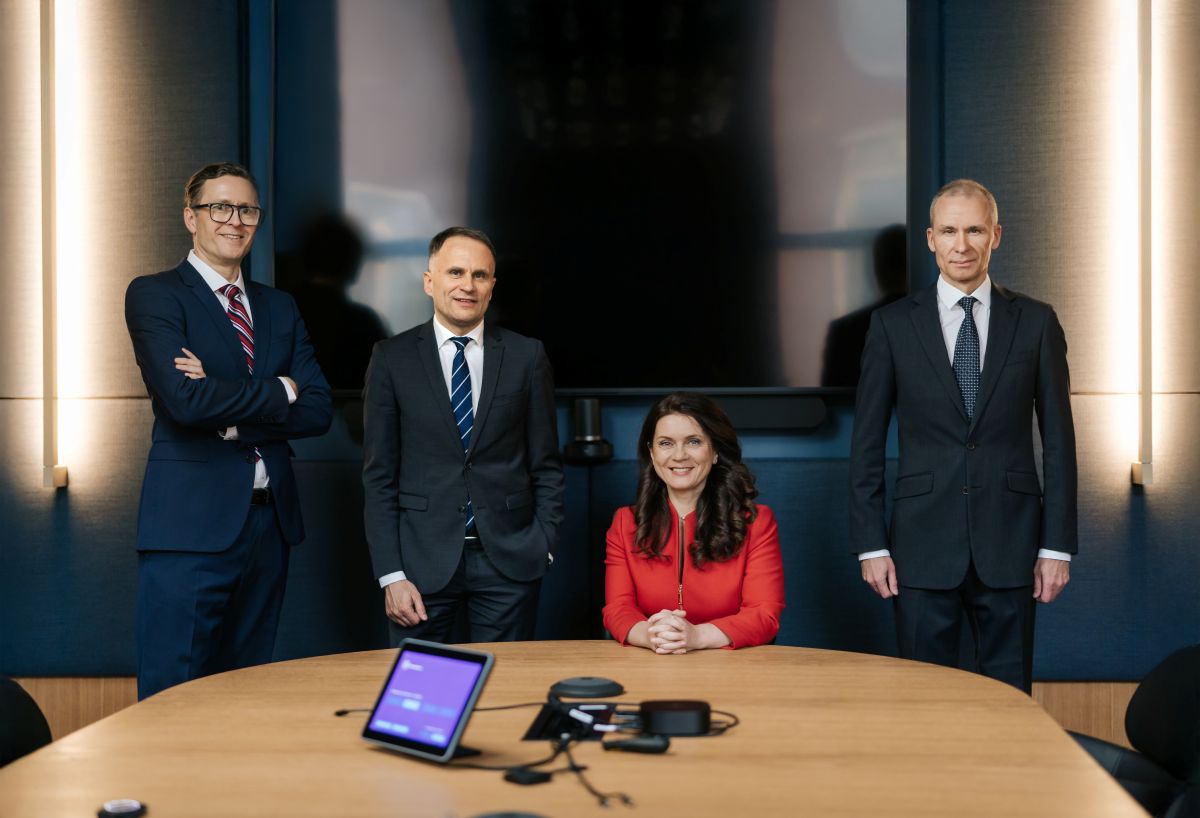
Finantsinspektsioon management board members from January 2026, from the left: Gerd Laub and Andre Nõmm, chair of the board Kerstin Pilt, and board member Andres Kurgpõld.
The Finantsinspektsioon Yearbook 2025 gives a picture of the activities, priorities and choices of Finantsinspektsioon, or what was done and why. It also helps in understanding the direction we are moving forwards in and the reasons for that.
The financial sector needs to operate so that people and companies can manage their financial matters with certainty. This needs stability, transparency and trust in the market, and supervision that is risk-based, preventative and proportional. The role of Finantsinspektsioon is to stand up for those principles on behalf of the Estonian state. This is a highly responsible duty that can only be carried out with a strong organisational culture and very professional staff.
At the end of 2025 there were 146 people working at Finantsinspektsioon. An inevitable feature of a small country is that those people must all take on multiple roles. Their work is mostly hidden from public view, but its impact can be seen in the stability of the financial system and the trustworthiness of market participants. There were also 146 entities operating with a licence from Finantsinspektsioon the end of the year, so there is effectively one supervised entity for each member of staff at the supervisor.
Financial stability does not depend on supervision alone, but also on how market participants understand their own responsibilities, follow the requirements and support trust in the financial sector in their everyday work. It is consequently a priority for Finantsinspektsioon to maintain and develop the skills of its staff so that they are able to be good and reliable partners for market participants and carry out the mandate of Finantsinspektsioon in an ever more complex and technological environment.
Technological development was also a major supervisory priority in 2025. An important step was that the DORA regulation started to apply, harmonising the requirements in the European Union for digital continuity and IT risk management. Finantsinspektsioon held an information seminar on this for market participants, extended its notification systems for serious IT incidents, and started to collect regular information on providers of critical IT services. Those steps will strengthen resilience in the financial sector and will help reduce excessive dependence on individual service providers.
Technological changes meant that risks also changed. Financial frauds became more common in 2025, which was also reflected in an increase in the number of consumer complaints submitted to Finantsinspektsioon. This underlined the need to strengthen protection of end consumers and prevent the abuse of the financial sector. Finantsinspektsioon published 844 alerts during the year about people operating without a licence and possible frauds, and continued to raise awareness of financial matters.
The capacity to deal with crises was another of the central themes of the year. Finantsinspektsioon extended the crisis resolution programmes of systemically important banks and tested the operation of crisis resolution at the national level. This was done to make sure that the financial system would operate and depositors would maintain confidence in it even in extreme circumstances.
Supervision does not just mean inspections. It also means guidance, explanations and dialogue. Finantsinspektsioon issued 21 advisory guidelines in 2025 and took an active part in shaping the legislative environment of Europe and of Estonia. It also took in proposals for how to simplify the legislation and reduce the administrative burden, as clear and predictable supervision is a key element for providing confidence in the financial environment.
The year 2025 was the final year of the Finantsinspektsioon strategy period 2022–2025. A new management had already started setting the directions for the next strategy period at the time this annual report was written. Maintaining continuity while at the same time looking to the future is very important for the new management. The years 2026–2029 are certain to bring new technological developments, changes in the European regulatory framework, and challenges arising from geopolitical tensions and volatility in the economic environment.
The strategic direction for Finantsinspektsioon is clear, as we must maintain financial stability and increase transparency, carry out risk-based and preventative supervision, develop our crisis resolution and digital capacities, help interpret complex legislation, stand up for consumers, and act against abuse of the financial sector.
The central focus of the work of Finantsinspektsioon is on the public interest and trust in the financial system. This trust does not arise all by itself, but it is created by constant, professional and transparent work.
Kerstin Pilt
chair of the management board